
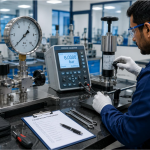
Pressure gauges play an important role in monitoring industrial processes, maintaining equipment performance and supporting safe operations. From manufacturing facilities and MEP contractors to oil and gas operations, water treatment plants and industrial maintenance companies, reliable pressure measurement is essential across many industries in Dubai and Sharjah.
Over time, pressure gauges can develop measurement errors because of regular use, mechanical wear, vibration, pressure fluctuations and demanding operating conditions. These changes may go unnoticed until an instrument is checked against a suitable reference standard.
Pressure gauge calibration in Dubai and Sharjah helps businesses evaluate instrument accuracy, identify measurement deviations and maintain appropriate calibration records for their equipment.
In this guide, Caltech explains why pressure gauge calibration matters, which industries commonly require it, how the calibration process works, and what businesses should consider when selecting a pressure calibration service provider in the UAE.
Table of Contents
- Why Is Pressure Gauge Calibration Important?
- Which Industries Need Pressure Gauge Calibration in Dubai and Sharjah?
- Which Types of Pressure Instruments Can Be Calibrated?
- How Does Pressure Gauge Calibration Work?
- On-Site vs Off-Site Pressure Gauge Calibration
- How Often Should Pressure Gauges Be Calibrated?
- What Should a Pressure Gauge Calibration Certificate Include?
- How to Choose a Pressure Calibration Service Provider in the UAE
- How Caltech Supports Pressure Calibration Requirements
- Frequently Asked Questions
- Conclusion
Why Is Pressure Gauge Calibration Important?
Pressure gauges indicate the pressure within a system or process. Their readings help operators monitor operating conditions, investigate equipment problems and determine whether a system is working within its specified limits.
However, a pressure gauge does not necessarily remain accurate throughout its service life. Its performance can change because of mechanical stress, ageing, environmental conditions or damage.
Regular calibration helps businesses understand the condition of their instruments and determine whether their readings meet the requirements of the intended application.
1. Maintaining measurement accuracy
Calibration compares an instrument’s indicated readings with values provided by a suitable reference standard.
For example, if a pressure reference indicates 6 bar while a gauge displays 6.1 bar, the difference between the readings is 0.1 bar. Whether this difference is acceptable depends on the gauge’s specifications and the requirements of the application.
Calibration results help identify measurement errors and evaluate whether an instrument remains suitable for use.
2. Supporting industrial safety
Pressure gauges are used in compressors, pumps, hydraulic systems, pipelines and other pressurised equipment.
Incorrect readings may lead to unsuitable operating decisions or delay the identification of developing equipment problems. Calibration supports reliable measurement, but it must be combined with appropriate inspections, maintenance and safety controls.
3. Improving process consistency
Manufacturing and industrial processes may depend on maintaining pressure within a specified range. Inaccurate measurements can affect process adjustments and product consistency.
Calibrated instruments provide documented information that helps operators make informed decisions about their measurement equipment.
4. Supporting quality management
Businesses may need calibration records for internal quality procedures, customer requirements and audits.
Appropriate calibration documentation helps demonstrate how measurement equipment has been evaluated and whether the results meet the applicable acceptance criteria.
5. Identifying instruments that need attention
Calibration can reveal instruments that require further investigation, adjustment, repair or replacement.
Reviewing historical results can also help businesses identify recurring problems and establish appropriate calibration intervals.
Which Industries Need Pressure Gauge Calibration in Dubai and Sharjah?
Pressure measurement is important across several industrial and commercial sectors in the UAE. The exact calibration requirements depend on the equipment, application and relevant quality or safety procedures.
Manufacturing and industrial production
Manufacturing facilities use pressure gauges on production machinery, compressed-air systems, hydraulic equipment and process lines.
Reliable pressure readings help operators monitor equipment performance and maintain the required operating conditions.
Industrial facilities can benefit from maintaining an equipment register that records each gauge’s identification, location, measurement range, calibration status and next scheduled calibration date.
Oil and gas
Pressure instruments are used in various oil and gas applications, including process equipment, pressure testing arrangements, pumps and associated systems.
Depending on the application, measurement accuracy and documented calibration results may be important to maintenance procedures, operational requirements and customer inspections.
The required calibration capability should always match the instrument’s measurement range and the specific technical requirements.
Construction and MEP contractors
Mechanical, electrical and plumbing contractors may use pressure gauges during equipment installation, testing, commissioning and maintenance.
Examples include pressure measurements associated with pumps, water systems, HVAC equipment and other mechanical installations.
Calibration helps contractors assess whether their instruments remain suitable for the work being performed and meet relevant project requirements.
HVAC and facilities management
Pressure measurements can support the operation and maintenance of chillers, pumps, compressors and building services equipment.
Facilities management teams may use pressure gauges to investigate abnormal readings, assess equipment conditions and support routine maintenance.
Maintaining suitable calibration records helps keep track of instruments used by technicians across different buildings or facilities.
Water treatment and utilities
Pressure gauges may be used in pumping stations, filtration systems, water distribution equipment and industrial treatment processes.
Reliable readings help operators monitor system conditions and identify measurement issues that could affect maintenance decisions.
Marine and shipyard operations
Marine service providers and shipyards may use pressure gauges on hydraulic systems, compressors, testing equipment and other machinery.
Calibration requirements can vary according to the equipment, vessel, project specifications and customer procedures.
Warehousing and industrial logistics
Some warehouses and logistics facilities use pressure instruments in maintenance workshops, compressed-air installations and specialised equipment.
Where pressure readings influence operational decisions, businesses should establish suitable inspection and calibration procedures.
Which Types of Pressure Instruments Can Be Calibrated?
Pressure calibration requirements vary according to the instrument’s design, range, accuracy and application.
Depending on technical suitability and service availability, Caltech may support calibration requirements for instruments such as:
- Analogue pressure gauges
- Digital pressure gauges
- Pressure transmitters
- Pressure transducers
- Pressure switches
- Differential pressure gauges
- Vacuum gauges
- Barometers
- Manometers
- Pressure sensors and related measurement devices
Not every instrument can be calibrated using the same procedure or reference equipment. Before arranging a service, customers should provide the instrument manufacturer, model, measurement range, required accuracy and intended application.
This information allows the service requirements to be reviewed before the work is confirmed.
How Does Pressure Gauge Calibration Work?
The calibration procedure depends on the instrument and its required measurement range. A typical process includes the following stages.
Step 1: Instrument identification
The instrument is identified using available information such as the manufacturer, model, serial number, pressure range and pressure unit.
The gauge is also inspected for visible damage or other conditions that could affect the calibration process.
Step 2: Selection of suitable reference equipment
A suitable pressure reference is selected based on the gauge’s measurement range and the required measurement capability.
The reference equipment should have appropriate calibration documentation and measurement traceability for the intended purpose.
Step 3: Application of pressure
Pressure is applied at selected points across the instrument’s measurement range, according to the agreed procedure.
Depending on the method, readings may be taken at increasing and decreasing pressure points to evaluate different aspects of the instrument’s performance.
Step 4: Comparison of readings
The indicated readings are compared with the reference values. The differences are recorded and evaluated against the applicable acceptance criteria.
Calibration may identify indication error, repeatability differences or other measurement characteristics relevant to the procedure.
Step 5: Evaluation of results
The results are reviewed to determine whether the instrument meets the required criteria.
If the instrument is outside the acceptable limits, further action may be required. Depending on the instrument and customer authorisation, this may include adjustment, repair, replacement or an assessment of the instrument’s suitability for use.
Step 6: Calibration documentation
The results are recorded in the applicable calibration certificate or report.
The documentation provides information about the instrument and the work performed, helping the customer maintain an appropriate equipment history.
On-Site vs Off-Site Pressure Gauge Calibration
Businesses arranging pressure gauge calibration in Dubai or Sharjah may need to decide whether the service should be carried out at their premises or through an off-site calibration arrangement.
The most appropriate option depends on the instrument, measurement requirements, installation, quantity and operational circumstances.
When on-site pressure calibration may be suitable
On-site calibration may be useful when instruments are installed in difficult-to-access locations or when removing equipment could disrupt operations.
It may be worth considering when:
- Multiple gauges are installed at the same facility.
- Equipment removal requires additional maintenance work.
- The instruments are difficult to transport.
- The customer wants to coordinate calibration with planned maintenance.
- The required measurement capability can be provided at the site.
On-site calibration is not automatically suitable for every instrument. The service provider must confirm that the available equipment, procedure and environmental conditions are appropriate.
When off-site calibration may be suitable
Off-site calibration may be appropriate for portable instruments that can be removed safely and transported to the designated service facility.
It may be considered when the required procedure or reference equipment is available through an off-site arrangement, or when the instrument needs further inspection.
Customers should confirm transport arrangements, expected turnaround, documentation requirements and any preparation needed before sending instruments.
Which option should your business choose?
There is no single option that is best for every pressure gauge.
A suitable decision should consider measurement requirements, instrument accessibility, operational downtime, service availability and the technical capability needed for the work.
Caltech can review suitable requirements for pressure calibration in Sharjah and Dubai and confirm the available service arrangement before a quotation is finalised.
How Often Should Pressure Gauges Be Calibrated?
Pressure gauge calibration intervals should be established according to the instrument and its intended application.
Some businesses use annual calibration schedules, but a 12-month interval is not automatically suitable for every gauge.
Important factors include:
- Manufacturer recommendations
- Previous calibration results
- Frequency of use
- Exposure to vibration, pressure surges and harsh environments
- Required measurement accuracy
- The consequences of incorrect readings
- Customer, contractual and quality management requirements
Instruments used in critical applications or demanding conditions may require more frequent checks. Where historical results demonstrate stable performance, an organisation may review its interval according to its documented procedures and applicable requirements.
Businesses should also consider calibration after an instrument has been dropped, repaired, adjusted or exposed to conditions that may affect its performance.
A well-maintained calibration register can help track instrument status, previous results and upcoming calibration dates.
What Should a Pressure Gauge Calibration Certificate Include?
The information provided in a calibration certificate depends on the calibration procedure, reporting requirements and service scope.
Customers may need to review the following details:
- Instrument description and identification
- Manufacturer, model and serial number, where available
- Measurement range and pressure unit
- Calibration date
- Reference values and observed readings
- Measurement errors or deviations
- Applicable acceptance criteria, where agreed
- Measurement uncertainty information, where applicable
- Reference equipment and traceability information
- Environmental conditions, where relevant
- Identification of the issuing service provider
Customers should clarify their certificate requirements before booking the service, particularly when documentation is required for a customer audit, quality management system or project specification.
Important: Calibration traceability and accredited calibration are not interchangeable terms. If a customer requires ISO/IEC 17025-accredited calibration, the relevant provider’s accreditation and specific scope should be verified for the instrument and measurement range concerned.
How to Choose a Pressure Calibration Service Provider in the UAE
Selecting a pressure calibration provider involves more than comparing prices.
Businesses should check whether the service meets their technical and documentation requirements.
Check the measurement range
Confirm that the provider can support the required pressure range and instrument type.
Review the reference equipment
Ask about the suitability and calibration status of the reference equipment used for the requested service.
Confirm the calibration method
The procedure should be appropriate for the instrument and the required measurement points.
Understand the certificate requirements
Check which results and supporting details will be provided in the calibration documentation.
Verify accreditation when required
If an accredited calibration service is specified, check the applicable accreditation body’s records and confirm that the required service falls within the actual scope.
Discuss turnaround and logistics
Confirm how instruments will be handled, whether on-site service is available, and how collection, delivery and scheduling will be arranged.
Provide complete instrument details
Supplying an accurate equipment list can help the provider assess the requirements and prepare a suitable quotation.
How Caltech Supports Pressure Calibration Requirements
Caltech supports businesses seeking pressure calibration and related instrument services in Sharjah and Dubai.
The company facilitates calibration and testing through its third-party calibration service provider in Sharjah. Service arrangements depend on the instrument, measurement range, required accuracy and customer requirements.
Caltech’s pressure calibration support may cover suitable pressure gauges, transmitters, transducers, pressure switches, vacuum gauges and related instruments.
Services based on equipment requirements
Before confirming a service, Caltech reviews the available instrument details and the customer’s required measurement range, accuracy and documentation.
This helps establish whether the requested service can be supported and which arrangement is appropriate.
On-site and off-site options
On-site calibration may be available for suitable equipment and quantities. Off-site arrangements may be appropriate for portable instruments or services requiring a different setup.
Availability is confirmed according to the instrument and technical requirements.
Calibration documentation
Applicable calibration documentation can help businesses maintain equipment records and review the reported measurement results.
Customers should communicate any specific traceability, uncertainty or accreditation requirements before the service is arranged.
Support for multiple instrument types
Businesses with broader calibration requirements can also enquire about suitable electrical instruments, temperature and humidity devices, torque equipment and other supported measuring instruments.
For further information, visit the Caltech Pressure Calibration service page.
Frequently Asked Questions About Pressure Gauge Calibration
1. What is pressure gauge calibration?
Pressure gauge calibration compares the instrument’s readings with suitable reference values to determine its measurement error and evaluate its performance against specified requirements.
2. Why do pressure gauges need calibration?
Pressure gauges can develop measurement errors over time. Calibration helps identify these errors and determine whether an instrument remains suitable for its intended application.
3. Where can I arrange pressure gauge calibration in Dubai?
Businesses can contact Caltech to discuss pressure calibration requirements in Dubai. Service availability depends on the instrument, measurement range, technical requirements and agreed service arrangements.
4. Does Caltech support pressure calibration in Sharjah?
Caltech supports suitable pressure calibration requirements in Sharjah and Dubai. Customers should provide their instrument details to confirm the available service.
5. Is on-site pressure gauge calibration available?
On-site calibration may be available for suitable instruments and quantities. The service provider must first confirm that the required measurement capability and procedure can be provided at the customer’s premises.
6. How long does pressure gauge calibration take?
Turnaround depends on the instrument type, quantity, measurement range, service method and current capacity. Customers should confirm the expected completion time when requesting a quotation.
7. What information is needed to request a quotation?
Provide the instrument type, manufacturer, model, serial number where available, pressure range, quantity, service location and any specific certificate or accreditation requirements.
8. How often should a pressure gauge be calibrated?
The interval depends on usage, operating conditions, previous calibration results, required accuracy and applicable procedures. Businesses should establish and periodically review suitable intervals.
9. What is the difference between calibration and adjustment?
Calibration evaluates and documents the instrument’s readings against reference values. Adjustment changes the instrument’s response to reduce an identified error. These are separate activities.
10. Does calibration guarantee that a pressure gauge will remain accurate?
No. Calibration documents performance under the conditions and procedure used. Instrument performance can change after calibration because of wear, damage or operating conditions, so appropriate maintenance and recalibration intervals remain important.
Conclusion
Pressure gauge calibration is an important part of measurement control for businesses operating in Dubai, Sharjah and across the UAE.
Regular calibration helps identify measurement errors, evaluate instrument performance and maintain appropriate records for industrial equipment. Choosing between on-site and off-site calibration depends on the instrument, the required measurement capability and the operational needs of the facility.
Businesses should establish suitable calibration intervals, review their calibration results and verify that the selected service meets their technical, traceability and documentation requirements.
Caltech supports suitable pressure calibration requirements for businesses in Sharjah and Dubai, with service arrangements confirmed according to the equipment and customer needs.
Need Pressure Gauge Calibration in Dubai or Sharjah?
Contact Caltech to discuss your pressure gauges, transmitters and other suitable pressure instruments.
Provide your equipment details, measurement range, quantity, location and certificate requirements so the appropriate service can be reviewed.
Visit: Caltech Pressure Calibration Services
Website: https://caltech-eng.com/
Email: info@caltech-eng.com
Phone: +971 50 485 0456